Ground & Structural Improvements
 Life Extension
 Rescue Services
 Surveying & Sampling
 Waterproofing & Water Control
Port Remedial Services Cornwall
The port lighthouse pier has suffered from a lack of maintenance with failing joints and tidal erosion through seawater washing away the sub-base of the pier structure, and this has caused failure in the working surface for the local commercial Silly Isles ferry terminal.
DWG was requested to provide GPR data and, with the data, provide a solution to stabilise the jetty and ground using a Geopolymer resin. A drill plan was produced to execute a program to inject into the known voided areas to re-align and stabilise the structure.
This was a complex controlled process using pre-determined temperature and pressure settings to fill the voiding, support the structure to deal with the future loadings and not impact the quayside walls and push out any granite blocks rendering the jetty unusable if any block was dislodged.
Concrete Drilling Services
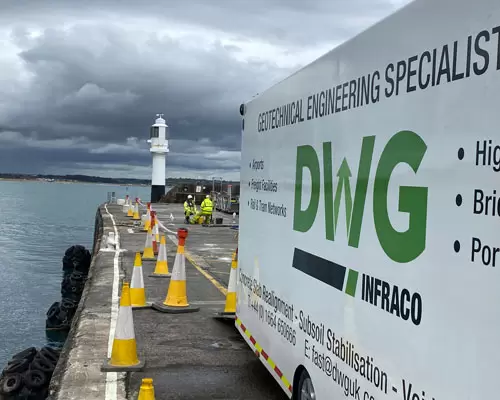
DWG owns its own plant and equipment and uses its support trailer, as seen on the lighthouse jetty photograph, which houses tools, equipment, pump and equipment spares to deal with any breakdowns which could impact scheduling and operations. It also carries a full 1st Aid facility.
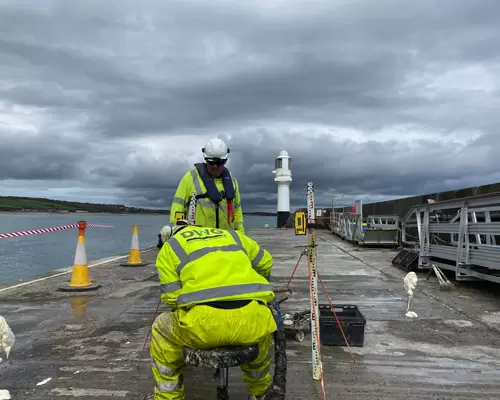
A drill plan was drawn to ensure no services/drains were compromised at approx. 1.5m centre with a minimum drill distance from a joint of 500mm maintained. Drilling was completed manually, using HAV live vibration monitoring to protect the well-being of the workforce. Drilling depths were into the lean mix and weak zones identified on the GPR.
Concrete Remedy Solutions
Once the drilling has been completed on each slab section, stabilisation injection commenced. The injection process involves monitoring of temperatures, pressures and flow rates of each component using the DWG-designed diaphragm pumps and heating technology. The operator controls the flow rates and temperature settings throughout the process, and the delivery of resin is through heat-controlled hoses directly into the injection point, which is anchored safely into the concrete base.
Laser equipment is used throughout the working area to monitor the movement of the worked location as well as the adjacent areas. Filling the voids was achieved through a series of multiple deliveries into the injection point to provide a reliable compressive strength throughout the operation, which will ensure the re-aligned levels are maintained going forwards to provide long-term stability.
The process also had to protect the structure against lateral movement of granite blocks, which could dislodge and impede ships mooring alongside if any blocks were pushed out through the works. This was monitored using laser technology and vigil visual inspections from both land and boat.
The works were completed on time and on budget with a handover to the client, including product TDS, COSHH, ITP’s and daily activity sheets, including volumes injected per IP and pre and post-GPR and CBR data. This work was completed during the UK Covid Lockdown, and no movement has been detected during subsequent monitoring records.